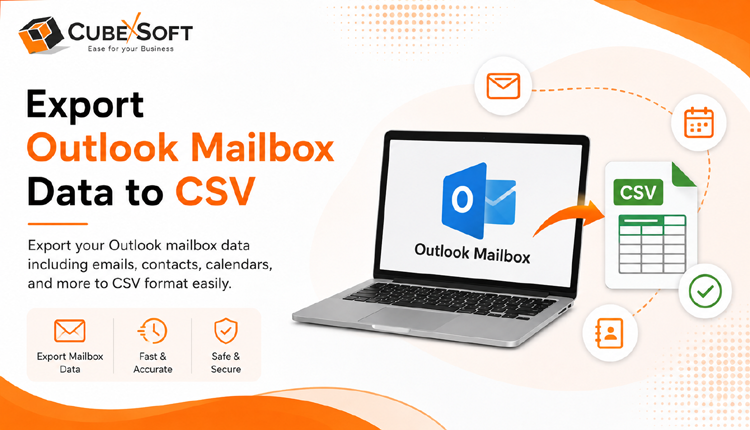
Summary: In the blog, we are explaining how to export Outlook emails to CSV format using simple and practical methods. The guide covers Outlook’s built-in export option, an Excel-based approach, and a professional PST conversion method for users who need to process emails in bulk. It also explains how to handle Outlook email data when you need organized records for reporting, analysis, migration, or backup. By the end of the blog, readers can choose the method that best suits their requirements and export Outlook email information to CSV more efficiently.
Why Export Outlook Emails to CSV File?
Exporting Outlook emails to CSV can make email information easier to organize, review, and use across different applications. Since CSV files are compatible with tools such as Microsoft Excel, Google Sheets, databases, and CRM platforms, users can work with email data without relying entirely on Outlook.
There are several situations where converting Outlook email information to CSV can be helpful:
- Keep an additional copy of important email details for record-keeping.
- Transfer sender, recipient, subject, and other email information to CRM systems.
- Prepare email data for business reports and analysis.
- Collect email addresses from Outlook messages for further management.
- Review and sort communication records in Excel or other spreadsheet tools.
- Preserve essential email metadata in a simple, portable format.
- Use Outlook email information with other applications during data migration.
Methods to Export Outlook Emails to CSV
Method 1: Export Outlook Emails to CSV Using the Import and Export Wizard
Microsoft Outlook provides a built-in Import and Export Wizard that lets users save mailbox data in CSV format. This is a convenient option when you need to export information from a single Outlook folder without installing additional software.
Steps to Export Outlook Emails to CSV
- Open Microsoft Outlook.
- Go to File and select Open & Export.
- Click Import/Export.
- Select Export to a file and click Next.
- Choose Comma Separated Values (CSV).
- Select the Outlook folder containing the data you want to export.
- Specify the location where you want to save the CSV file.
- Click Finish to start the export.
The resulting CSV file can be opened with spreadsheet applications for sorting, filtering, and further analysis.
Advantages
- Built into Microsoft Outlook.
- Does not require third-party software.
- Suitable for basic export requirements.
- Works well for smaller amounts of mailbox data.
Limitations
- Microsoft Outlook must be installed and accessible.
- Export options are relatively limited.
- Attachments are not included in the CSV output.
- Handling multiple PST files can be inconvenient.
- Large mailboxes may require considerable processing time.
Method 2: Export an Outlook Email List to CSV Using Excel
Microsoft Excel can be useful when you need to clean, organize, or customize exported Outlook information. This approach is particularly helpful for creating contact lists, preparing reports, or analyzing basic email metadata.
Steps to Convert an Outlook Email List to CSV
- First, export the required Outlook data using the Import and Export Wizard.
- Open the resulting CSV file in Microsoft Excel.
- Review and arrange the available columns.
- Remove fields that are not required.
- Sort or filter the information according to your needs.
- Save the modified file in CSV format.
This method gives users more control over how the exported information is presented and organized.
Advantages
- Simple way to organize exported data.
- Allows easy sorting and filtering.
- Useful for reports and mailing lists.
- Compatible with Excel and Google Sheets.
Limitations
- Requires manual data cleanup.
- Not practical for processing numerous PST files.
- Does not provide a complete mailbox conversion.
- Attachments and other complex email content are not included.
Method 3: Export Outlook Emails to CSV Using CubexSoft PST Converter
For users who need to process PST files more efficiently, the CubexSoft PST to CSV Converter Tool provides a dedicated way to convert Outlook mailbox data to CSV. The software is designed for users who need to handle multiple PST files, larger datasets, and additional email properties without relying entirely on Outlook.
The tool also supports other conversion requirements, including exporting Outlook emails to PDF.
Steps to Export Outlook Emails to CSV
- Install and open the CubexSoft PST Converter Tool.
- Add one or more PST files to the application.
- Browse and preview the available mailbox folders.
- Select CSV as the desired output format.
- Apply filters such as date range, folder, sender, recipient, or email status if required.
- Select a destination folder for the exported data.
- Click Convert to start the process.
- Open the generated CSV files and verify the exported information.
Key Features
- Convert data from multiple PST files in a single operation, which can be useful for business and administrative tasks.
- Designed to process both smaller and larger Outlook data files.
- Retains available email details such as sender, recipient, subject, dates, folders, and other properties during conversion.
- Apply filters to export only the required messages based on criteria such as date, subject, sender, recipient, folder, or read/unread status.
- Review mailbox folders and messages before beginning the conversion.
- Process PST files without having to export each mailbox manually through Outlook.
- Provides a straightforward workflow for both technical and non-technical users.
- The conversion process works with a copy of the PST data, helping keep the original file unchanged.
Manual Method vs. CubexSoft Outlook PST Converter
Choosing between a manual export method and dedicated PST conversion software depends on the amount of data, required output, and level of automation. Outlook’s built-in options can work well for occasional exports, while CubexSoft is designed for users who need more control when processing PST files. According to CubexSoft’s official documentation, its Outlook Converter supports CSV and multiple other output formats, batch PST processing, selective conversion, and filtering options.
| Feature | Manual Method | CubexSoft Outlook PST Converter |
| Ease of use | Requires several manual steps | Guided conversion process |
| Outlook installation | Generally required | Not required for PST export |
| Multiple PST files | Limited/manual | Supports batch processing |
| CSV export | Available through Outlook options | Supported directly |
| Email filtering | Basic | Date, To, From, and Subject filters |
| Selective folder export | Available | Supported with preview |
| Large PST handling | Can be time-consuming | Designed for larger PST files |
| Other output formats | Limited | Supports multiple formats |
| Attachments | Limited in CSV workflows | Supports attachment export for supported output formats |
| Best suited for | Occasional, small-scale exports | Bulk conversion and advanced PST export |
Which Method Should You Choose?
If you only need to export a small amount of Outlook information occasionally, the manual approach can be sufficient and avoids installing additional software. However, when working with multiple PST files or requiring selective conversion and filtering, a dedicated converter can reduce repetitive work. CubexSoft specifically provides batch processing, preview, date-based filtering, and multiple output options.
Note: CSV is primarily a tabular format, so it is best suited for email information and metadata rather than preserving the complete visual content of messages and attachments.
Conclusion
Turning Outlook email data into CSV format can make it much easier to sort, review, analyze, and use email records in other applications. Outlook is suitable for simple exports, while Excel can be used afterward to clean up the data or create customized reports.
When the task involves several PST files, large mailboxes, selective export, or working on a system without Outlook, a reliable PST converter can save considerable time. The CubexSoft PST File Converter Tool provides a straightforward way to process PST files and export the required email information to CSV. Choosing the right method ultimately depends on the volume of data and the level of control you need over the export.
Frequently Asked Questions
Q1. Is it possible to save Outlook emails in CSV format?
Yes. Outlook provides an export option that can save supported email information in CSV format. The resulting file can then be viewed or processed using spreadsheet applications.
Q2. Will email attachments be included in a CSV file?
No. CSV is designed for structured text and tabular information, so it cannot contain the actual attachment files. Only supported email details can be stored in the CSV output.
Q3. What is the easiest way to export many Outlook emails to CSV?
For a small number of messages, Outlook’s built-in export feature may be enough. For larger datasets or multiple PST files, using dedicated conversion software can reduce the amount of manual work involved.
Q4. Can PST files be converted when Outlook is not installed?
Yes. PST conversion software can work directly with existing PST files, allowing users to extract email information without opening the Outlook application.
Q5. Which email details are normally available in CSV output?
The available information depends on the conversion method, but it can include fields such as sender, recipient, subject, message dates, folder names, and other email properties.
Q6. Can CSV replace PST as an Outlook backup?
Not completely. CSV is useful for keeping searchable email information and metadata, but it does not preserve the complete mailbox experience, including original formatting, attachments, and folder structure. PST is more suitable when a full Outlook mailbox backup is required.
Q7. Can CSV files exported from Outlook be opened in Excel?
Yes. A CSV file can be opened in Microsoft Excel and other spreadsheet programs. Once opened, users can sort, filter, edit, and analyze the available email data.
Q8. Which tool should I use to convert Outlook PST to CSV?
For occasional exports, Outlook’s native tools may be sufficient. If you need to handle multiple PST files, apply filters, or automate a larger conversion task, the PST File Converter Tool can be a convenient alternative.