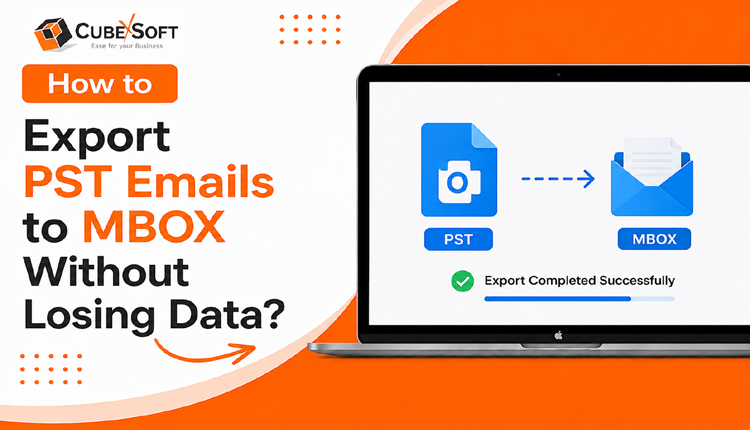
Microsoft Outlook stores emails and other mailbox information in PST (Personal Storage Table) files, whereas email clients such as Mozilla Thunderbird, Apple Mail, SeaMonkey, and Eudora commonly use the MBOX format. So, if you’re moving away from Outlook, migrating to another email application, or switching to a different operating system, you may need to convert your PST data into MBOX.
The challenge becomes greater when you want to convert PST to MBOX without Outlook. This situation can arise when Outlook is no longer installed, the PST file belongs to an old archive, or you need to access the mailbox on a non-Windows system. While manual workarounds are available, they can involve several steps and may require additional applications or an intermediate email account. There is also a risk of losing folder structure, attachments, or other mailbox information during the process.
In this guide, we’ll explore practical ways to convert PST to MBOX with attachments, including a manual approach and an automated option using the CubexSoft PST Converter Tool. This will help you understand how each method works and choose the approach that best fits your migration requirements.
Why Do Users Migrate from PST to MBOX?
Moving from Outlook to another email application is one of the most common reasons for converting PST files. MBOX is supported by a wide range of desktop email clients, making it a practical choice when users need greater flexibility.
Some common migration scenarios include:
- Moving from Microsoft Outlook to Thunderbird or Apple Mail.
- Accessing archived Outlook emails on macOS or Linux.
- Opening older mailbox data without keeping Outlook installed.
- Creating portable email archives in MBOX format.
- Moving messages and attachments to an MBOX-compatible application.
- Consolidating mailbox data from different Outlook accounts.
- Migrating email collections between supported desktop clients.
Because MBOX is not tied to a single email application, it can be convenient for users who regularly work across different platforms.
Is PST to MBOX Conversion Possible Without Outlook?
Yes. A PST file can be processed without having Microsoft Outlook installed, provided you use software capable of reading the PST structure independently.
Manual approaches generally depend on Outlook and another email client, which makes them unsuitable when Outlook is unavailable. A dedicated converter removes this dependency by loading the PST directly and providing MBOX as an output option.
This can be especially useful when working with an old PST archive, a mailbox copied from another computer, or a migration where Outlook is not part of the new environment.
Depending on the software used, you may also be able to:
- Process ANSI and Unicode PST files.
- Select specific folders instead of converting everything.
- Export multiple PST files in one session.
- Retain the existing folder organization.
- Include attachments and message formatting.
- Filter mailbox data before starting the export.
For a small mailbox, a manual workaround may be sufficient. For larger archives, direct conversion is generally more convenient because it avoids repeated synchronization and export steps.
Manual Approach: PST to MBOX Using Outlook and Thunderbird
Since Outlook does not provide a direct Export to MBOX option, one workaround is to use Thunderbird as an intermediate application.
Step 1: Open the PST in Outlook
- Launch Microsoft Outlook.
- Select File > Open & Export > Open Outlook Data File.
- Browse to the location of the PST file.
- Select the file and open it.
- Check that the required folders and messages are accessible.
Step 2: Install Thunderbird
Download and install Mozilla Thunderbird on the same computer. Once installation is complete, configure the email account you intend to use for the migration.
Step 3: Synchronize the Mailbox
If your workflow uses an IMAP account as an intermediary, add the same account to Outlook and Thunderbird. Copy the required messages from the PST folders to the corresponding IMAP folders and allow the synchronization to finish.
The amount of time required depends on the mailbox size and the number of attachments.
Step 4: Export the Messages
After the messages become available in Thunderbird, use a compatible mailbox export extension such as ImportExportTools NG to save the required folders in MBOX format.
Advantages of This Approach
- Does not require purchasing a dedicated converter.
- Can work for relatively small mailboxes.
- Useful for users who already have Outlook and Thunderbird installed.
Drawbacks to Consider
- Outlook is required.
- The process involves several applications.
- Synchronizing a large mailbox can take considerable time.
- Internet connectivity may be necessary when using an IMAP intermediary.
- The resulting folder organization may require manual checking.
- It becomes inconvenient when several PST files need to be processed.
For a one-time migration involving a few folders, these limitations may be acceptable. They become more noticeable when handling large archives.
Alternative Workaround: Use Gmail as an Intermediate Account
Another possible route is to move the messages from Outlook to a Gmail account and then access that account through Thunderbird before exporting the mailbox.
Step 1: Configure Gmail in Outlook
Open Outlook and add your Gmail account. Complete the account setup and allow the mailbox to synchronize.
Step 2: Move PST Messages to Gmail
Open the PST folders in Outlook, select the messages you want to migrate, and copy them into the appropriate Gmail folders. Keep Outlook running until synchronization has completed.
Step 3: Add Gmail to Thunderbird
Open Thunderbird and configure the same Gmail account. Allow Thunderbird enough time to synchronize the messages from the server.
Step 4: Export the Mailbox
After the messages are available locally, use an appropriate Thunderbird export utility to save the selected folders as MBOX files.
When Is This Method Useful?
This workaround can be suitable when you only need to move a limited amount of email and already have enough Gmail storage. However, uploading and downloading a large archive introduces another stage to the migration and can make the overall process considerably slower.
Why Manual Conversion May Not Be Ideal for Large PST Files
Manual migration can work, but its practical limitations become clear when the mailbox contains years of correspondence.
| Limitation | What It Means |
| Multiple applications | Outlook, Thunderbird, and possibly an online mail account may be involved. |
| Lengthy process | Large mailboxes can take substantial time to synchronize and export. |
| Outlook dependency | Many manual workflows cannot begin without access to Outlook. |
| Internet dependency | IMAP-based approaches require reliable connectivity. |
| Storage requirements | Intermediate online accounts may not have enough space for large archives. |
| Repeated work | Each additional PST or folder can require more manual handling. |
| Verification required | The converted mailbox should be checked for missing messages and attachments. |
These drawbacks do not necessarily make manual conversion unusable, but they make it less attractive for large-scale migrations.
Automated Way to Convert PST to MBOX Without Outlook
When Outlook is unavailable or the mailbox is too large for a manual workflow, specialized conversion software can provide a more direct route.
The CubexSoft PST Converter Tool is designed to read PST files independently and export their contents into MBOX format. This eliminates the need to configure Outlook, synchronize messages through an online account, and then export them from another application.
The tool can be useful for both individual mailbox migrations and larger conversion jobs. Users can add PST files, select MBOX as the destination format, and save the converted data to a chosen location.
How to Convert PST to MBOX Using CubexSoft
The conversion process can be completed in a few basic steps:
- Launch the software after installing the CubexSoft PST to MBOX Converter Tool.
- Add the PST file or folder containing the Outlook data you want to process.
- Review the available mailbox folders and select the data required for conversion.
- Choose MBOX from the available output formats.
- Select an output location where the converted files will be stored.
- Start the conversion and wait for the process to finish.
- Open the resulting MBOX data in your preferred compatible email client and verify the messages.
Keeping the original PST file untouched until the migration has been checked is recommended.
Conclusion
PST and MBOX serve different email ecosystems, so moving from Outlook to an MBOX-compatible application requires an appropriate conversion process. Manual workarounds involving Outlook, Thunderbird, or an intermediate Gmail account can be useful for smaller migrations, but they involve several steps and can become cumbersome as mailbox size increases.
For users who need a more direct workflow, the CubexSoft PST File Converter Tool provides an alternative that does not depend on Microsoft Outlook. It can be used to process PST files and export mailbox data into MBOX while reducing the manual effort involved in the migration.
Whichever option you choose, keep a backup of your source PST and verify the resulting MBOX files before completing the migration.
Frequently Asked Questions
Can I convert a PST file to MBOX without installing Outlook?
Yes. A dedicated PST conversion application can read the PST file directly, allowing you to perform the conversion without having Microsoft Outlook installed.
How can I transfer PST emails with attachments to MBOX?
You can use a manual Outlook to Thunderbird workflow or dedicated conversion software. Before deleting the source PST, verify that the converted MBOX contains the expected messages and attachments.
Which applications can open MBOX files?
MBOX is used by several email applications, including Mozilla Thunderbird, Apple Mail, SeaMonkey, Eudora, Postbox, Claws Mail, and other compatible clients. Support and import procedures can vary between applications.
Can multiple PST files be converted together?
This depends on the converter you use. Tools that provide batch processing can handle multiple PST files in one operation, which is more convenient than processing each mailbox individually.
Will the original PST folder structure be preserved?
The result depends on the conversion method and software. Dedicated converters are generally better suited to retaining mailbox folders and subfolders, but the output should always be verified in the destination application.
Is manual PST to MBOX conversion completely free?
The basic manual workflow can be performed without purchasing dedicated conversion software, but it may involve Outlook, Thunderbird, an IMAP account, and additional utilities. The process can therefore require more time and effort than an automated converter.