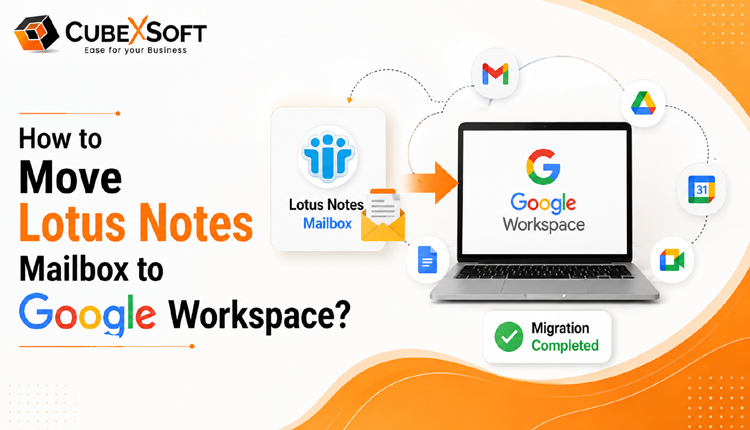
Many businesses are replacing traditional email platforms with cloud-based productivity suites to improve communication, strengthen security, and enable seamless collaboration. While IBM Lotus Notes (HCL Notes) is still used by some organizations, many are now transitioning to Google Workspace to take advantage of modern tools such as Gmail, Google Drive, Google Meet, Google Calendar, and other cloud applications that support remote and hybrid work environments.
If you’re planning to make the switch, this guide explains the most effective ways to migrate Lotus Notes to Google Workspace without compromising your mailbox data. You’ll learn both manual and automated migration methods, along with their benefits and limitations, helping you choose the approach that best fits your organization’s requirements for a smooth and secure migration.
Benefits of Moving from Lotus Notes to Google Workspace
Organizations are increasingly adopting Google Workspace to replace legacy email platforms like Lotus Notes because it offers a flexible, cloud-based environment that simplifies communication, collaboration, and IT management. Instead of relying on on-premises infrastructure, businesses can access their data securely from virtually anywhere while benefiting from Google’s continuously updated productivity tools.
Some of the major advantages of migrating from Lotus Notes to Google Workspace include:
- Access your data from anywhere: View emails, calendars, contacts, and files from any computer, tablet, or smartphone with an internet connection.
- Lower IT and maintenance costs: Eliminate the need to manage complex email servers and reduce hardware and infrastructure expenses.
- Improve collaboration: Work more efficiently using integrated applications like Gmail, Google Drive, Google Docs, Google Meet, and Google Calendar for real-time collaboration.
- Enhanced security and spam protection: Protect business data with Google’s built-in security features, spam filtering, encryption, and advanced threat detection.
- Scalable cloud storage: Increase storage capacity as your organization grows without investing in additional physical storage infrastructure.
- Automatic updates and minimal administration: Receive the latest features, security enhancements, and performance improvements automatically without manual upgrades.
- Boost workplace productivity: Enable employees to communicate, share files, schedule meetings, and collaborate seamlessly from a single cloud-based platform.
Challenges You May Face When Migrating Lotus Notes to Google Workspace
Although migrating from Lotus Notes to Google Workspace offers many advantages, the process can be challenging if it is not planned properly. Compatibility issues, data integrity concerns, and lengthy migration times are some of the common obstacles organizations encounter during the transition.
Below are the most common challenges users experience:
- NSF file compatibility: Lotus Notes stores mailbox data in NSF files, which Google Workspace cannot import directly. The data must first be converted or migrated using a compatible solution.
- Maintaining data integrity: Preserving email formatting, attachments, metadata, folder structure, and other mailbox properties is essential to ensure no information is altered during migration.
- Time-consuming manual process: Free migration methods often require several manual steps, making the overall process slower, especially for large mailboxes.
- Migrating complete mailbox data: In addition to emails, users often need to transfer contacts, calendars, journals, and other mailbox items, which many manual methods do not fully support.
Manual Ways to Move Lotus Notes to Google Workspace
If you’re looking for a cost-free approach, there are a couple of manual methods that can help transfer Lotus Notes data to Google Workspace. However, these methods are generally suitable for small-scale migrations.
Method 1: Export Emails Using an Email Client
One common approach is to use an email client such as Mozilla Thunderbird as an intermediary.
Steps:
- Launch IBM Lotus Notes.
- Export or synchronize your mailbox with an IMAP-enabled email account.
- Install and configure Mozilla Thunderbird.
- Add both the source email account and your Google Workspace Gmail account to Thunderbird.
- Drag and drop the required emails from the Lotus Notes mailbox into the Gmail folders.
- Allow Thunderbird to synchronize the data with your Google Workspace account.
Method 2: Use Google Workspace Data Migration Service
Google Workspace includes a built-in Data Migration Service that supports IMAP-based migrations.
Steps:
- Sign in to the Google Workspace Admin Console.
- Open the Data Migration tool.
- Choose IMAP as the migration source (if Lotus Notes mail is accessible through IMAP).
- Enter the source server details and user credentials.
- Configure the migration settings.
- Start the migration and monitor its progress.
Note: Since Google Workspace does not support direct NSF file imports, this method only works when Lotus Notes mail is available through an IMAP server.
Limitations of Manual Migration Methods
While free migration techniques can be useful for small mailbox transfers, they have several drawbacks that make them unsuitable for business or enterprise migrations.
Some common limitations include:
- The migration process can take a significant amount of time.
- There is a higher risk of missing emails, attachments, or other mailbox data.
- NSF files cannot be imported directly into Google Workspace.
- Most manual methods transfer only emails, leaving contacts, calendars, journals, and other data behind.
- Folder hierarchy and mailbox organization may change after migration.
- Technical knowledge is often required to complete the process successfully.
- No detailed migration reports or activity logs are generated.
- There is no dedicated technical support if errors occur during migration.
Professional Solution to Bulk Migrate Lotus Notes to Google Workspace
For organizations and users who need a faster, more reliable migration, a professional migration tool can simplify the entire process. CubexSoft NSF Converter enables users to migrate Lotus Notes mailboxes to Google Workspace in bulk while preserving the original folder hierarchy, email formatting, attachments, metadata, and other mailbox properties.
The software features an intuitive interface, allowing both technical and non-technical users to complete the migration without configuring additional email clients. It also includes advanced filtering options, enabling users to migrate only the required data based on specific criteria.
In addition to emails, the application supports migrating contacts, calendars, and other Lotus Notes mailbox items to Google Workspace. It can also transfer Lotus Notes data to Microsoft 365, Gmail, and other IMAP-supported email services. Users can download the free demo version to evaluate the software’s features and understand the migration process before purchasing.
Quick Note
Before starting the migration, ensure that IBM Lotus Notes (HCL Notes) is installed on your computer, as it is required for accessing NSF files. The software includes dedicated options for migrating contacts and calendars separately, making it easier to transfer different mailbox components.
The free demo version allows users to migrate only the first 25 emails from each Lotus Notes mailbox to Google Workspace. If you need to migrate complete mailboxes or multiple NSF files without restrictions, you can upgrade to the licensed version.
Frequently Asked Questions
How can I migrate HCL Notes contacts to Google Workspace?
You can transfer HCL Notes contacts directly to your Google Workspace account by using the software’s dedicated Contacts Migration feature. This helps preserve contact information during the migration process.
Which migration method is best for Lotus Notes to Google Workspace?
The right method depends on the size of your migration. Manual techniques may work for users with only a few emails, but they require more time and technical effort. For larger migrations involving multiple NSF files or complete mailboxes, a professional solution is a more reliable choice because it supports bulk migration while maintaining the original folder hierarchy and mailbox structure.
Will email attachments be migrated as well?
Yes. The software migrates email attachments along with the corresponding messages, ensuring that your mailbox data remains complete after the migration.
Conclusion
Migrating from Lotus Notes to Google Workspace enables organizations to take advantage of a modern cloud-based collaboration platform while improving accessibility and productivity. In this guide, we’ve explored both manual and professional migration methods, along with their benefits, limitations, and common migration challenges.
For users with small mailboxes, manual methods can be a practical starting point. However, organizations managing larger volumes of data may benefit from a dedicated migration solution that offers faster processing, bulk migration capabilities, and better data integrity. If you need assistance during the migration process, the CubexSoft support team is available to help resolve technical issues and ensure a smooth transition to Google Workspace.