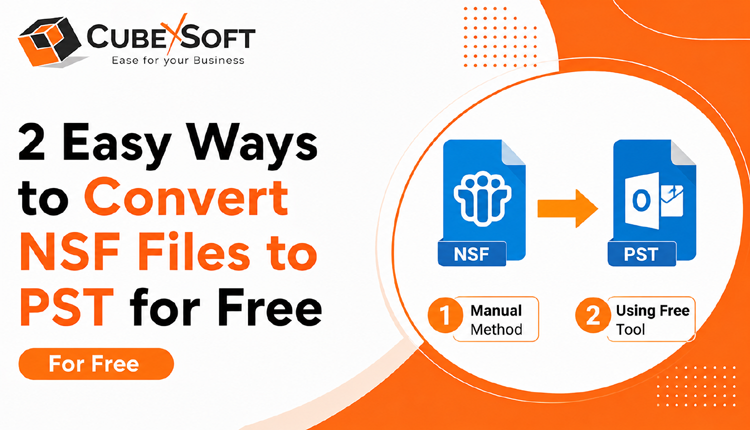
In this article, we’ll explain how to convert NSF files to PST without Lotus Notes and discuss the different options available for completing the migration. You’ll learn about the requirements, limitations, and possible challenges involved in moving emails, contacts, calendars, and other mailbox data from NSF to PST. By the end, you’ll have a clearer understanding of which method is best suited to your needs and how to approach the conversion safely.
“I previously used IBM Notes to manage my emails, contacts, and calendars, but I have now decided to move to Microsoft Outlook. My old mailbox data is still available in an NSF file, but I no longer have a working Lotus Notes installation. Outlook does not provide a direct option to import NSF files. Is there a practical way to convert my NSF data into PST without reinstalling Lotus Notes?”
Why Do Users Convert NSF to PST?
There are several reasons why users and organizations decide to move their data from Lotus Notes to Microsoft Outlook. Some of the most common ones include:
- Outlook is easier to use: Lotus Notes can feel complex, especially for users who are not familiar with its interface. Outlook offers a more familiar and straightforward experience, making the transition easier for many users.
- Access to a broader Microsoft ecosystem: Organizations using Microsoft 365 may prefer Outlook because it integrates smoothly with other Microsoft applications and services, allowing users to manage their work from a unified platform.
- Lower maintenance requirements: Managing a Lotus Notes environment can require additional administration and resources. Moving to Outlook, particularly in a Microsoft 365 environment, may simplify management and reduce ongoing maintenance for some organizations.
- Better compatibility with modern workflows: Outlook works closely with Microsoft 365 services and other commonly used business applications, making it a convenient choice for organizations looking to modernize their email environment.
Understanding the Difference Between NSF and PST Files
Before starting the migration, it is important to understand what NSF and PST files are and how they differ.
NSF File: NSF stands for Notes Storage Facility. It is the primary database file format used by IBM Lotus Notes and HCL Notes to store mailbox and other application data, including emails, contacts, calendars, tasks, notes, and journals.
PST File: PST stands for Personal Storage Table. Microsoft Outlook uses PST files to store mailbox information such as emails, contacts, calendars, tasks, and other Outlook data locally.
Although both file types can contain similar kinds of information, they are created for different email platforms and cannot be used interchangeably.
Can You Convert NSF to PST Without Lotus Notes?
In most cases, Lotus Notes or HCL Notes is required to access and process NSF data using the native methods. An NSF file is not a simple standalone document that can be opened and converted like a regular file. Its structure is designed to work within the Notes environment.
Without a suitable Notes installation or environment:
- You may not be able to open or properly access the contents of the NSF file.
- Outlook does not provide a native option to import NSF files directly.
- The built-in export and migration options available in Notes cannot be used without access to the Notes application.
Therefore, if you plan to use the manual conversion approach, having a working Lotus Notes or HCL Notes installation is an important prerequisite.
Can Third-Party Tools Convert NSF to PST Without Lotus Notes?
This is one of the most common questions among users who no longer have Lotus Notes installed. The answer can vary depending on the specific software and how it processes NSF files.
Some third-party NSF conversion applications are designed to read NSF databases independently, while others may require a Notes installation or specific Notes components. Therefore, users should check the software’s system requirements before purchasing or using any converter.
If the chosen solution requires Lotus Notes, you will need to install and configure the appropriate Notes environment before starting the conversion. Always verify the supported NSF versions, operating systems, and conversion capabilities beforehand.
How to Convert NSF to PST Manually?
If you have access to Lotus Notes and Microsoft Outlook, you can use an intermediate CSV file to move certain types of data. However, this is not a direct NSF to PST conversion and may not preserve every type of Outlook data or its original folder structure.
One commonly used approach is to export the required information from Lotus Notes into CSV format and then import that data into Outlook.
Step 1: Export NSF Data to CSV
Follow these steps to export supported data from Lotus Notes:
- Open Lotus Notes and access the required mailbox or database.
- Go to File and select Export.
- Choose a suitable location and enter a name for the exported file.
- Select Comma Separated Value (CSV) as the output format.
- Configure the available export options according to the data you want to transfer.
- Click Export to create the CSV file.
Once the CSV file has been created, it can be imported into Outlook using the appropriate Outlook import options. Keep in mind that this approach may require separate handling for different types of data, and it does not necessarily provide a complete migration of all NSF content into a PST file.
Step 2: Import the CSV File into Outlook
After exporting the required data from Lotus Notes to CSV, the next step is to import that file into Microsoft Outlook.
- Open Microsoft Outlook on your computer.
- Go to File and select Open & Export.
- Click Import/Export.
- Choose Import from Another Program or File and click Next.
- Select Comma Separated Values (CSV) and click Next.
- Browse to the CSV file you exported from Lotus Notes.
- Select the destination folder in Outlook where you want to import the data.
- Complete the import process and verify that the required items are available in Outlook.
This approach can be useful for transferring certain types of data, but it has several limitations when used as a complete NSF-to-PST migration method.
Limitations of the Manual NSF to PST Conversion Method
The manual approach may appear convenient because it does not require specialized conversion software. However, it is not ideal when you need to migrate an entire NSF database while preserving all of its original content and structure.
Some important limitations include:
- Not all NSF data may transfer: The CSV method is mainly suitable for supported data that can be exported in tabular form. Complex Notes data and certain item properties may not transfer correctly.
- Calendar and other data may require separate handling: Emails, contacts, calendars, notes, journals, and other Notes data do not necessarily follow the same export/import process.
- Folder structure may not be preserved: The original organization of the Notes database may not be retained after using CSV as an intermediate format.
- The process can be time-consuming: Exporting data from Notes and then importing it into Outlook requires multiple steps and may become tedious when dealing with a large database.
- Both applications may be required: If you are following the native manual method, you generally need access to a working Notes environment as well as Microsoft Outlook.
- Large migrations require additional planning: Before processing an entire mailbox, it is better to test the method with a small NSF database and verify the resulting Outlook data.
For these reasons, the manual method is more appropriate for users who have a limited amount of supported data to transfer. If you need to migrate a large NSF database or preserve a wider range of mailbox information, a dedicated conversion solution may be more practical.
Professional NSF to PST Converter for Large-Scale Migration
When manual export and import do not meet your requirements, a dedicated NSF to PST conversion application can simplify the migration. There are several tools available, so users should compare their supported NSF versions, output options, filtering capabilities, and system requirements before making a decision.
One such option is CubexSoft NSF Converter Software, which is designed to convert NSF data into PST and other supported formats. The software provides a guided interface that allows users to select NSF files, preview their contents, choose the required data, and export it to the desired format.
Why Consider an NSF to PST Converter?
A NSF to PST Converter can be useful when you need to process multiple NSF files or transfer a larger volume of mailbox data. Depending on the software and license, common features may include:
- Batch conversion: Multiple NSF files can be processed together instead of converting each file individually.
- Selective migration: Users can select specific folders or apply available filters to export only the required data.
- Support for different mailbox items: Depending on the tool and NSF database, the software may support emails, contacts, calendars, notes, journals, and other mailbox information.
- Folder hierarchy preservation: A dedicated converter may retain the original folder structure when creating the PST output.
- Preview functionality: Some tools allow users to preview NSF data before starting the export, making it easier to verify the source content.
- Outlook-compatible PST output: The converted data can be saved as a PST file that can then be opened or imported into a compatible version of Microsoft Outlook.
Before using any third-party application, it is recommended to test the free or trial version, where available, on a copy of your NSF data. This lets you verify the conversion quality and confirm that the resulting PST contains the information you need.
Final Thoughts
Converting NSF data to PST is not as straightforward as moving files between two applications that use the same storage format. The manual approach involves exporting supported data from Lotus Notes and importing it into Outlook, but it may not preserve every type of mailbox item, folder structure, or property.
For small amounts of data, the manual CSV-based method may be sufficient. However, users dealing with large NSF databases, multiple files, or a broader range of mailbox items may find a dedicated NSF to PST Converter more convenient.
Before starting the migration, always create a backup of the original NSF files and verify the converted PST data before relying on it as your primary Outlook mailbox.