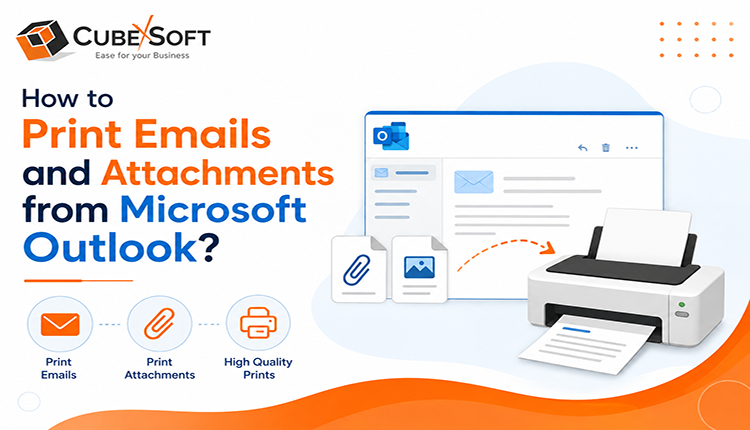
This guide explains practical ways to print emails and attachments from Microsoft Outlook. It covers Outlook’s built-in printing options, their limitations when handling multiple messages or large PST files, and an alternative solution for managing email data more efficiently. You’ll also learn how to save Outlook emails as PDFs, organize attachments, preserve email formatting, and process multiple messages in less time. The guide is useful for business records, legal documentation, offline backups, and anyone who needs a simple way to manage Outlook email data.
Reasons to Print Outlook Emails
Printing emails can be useful when important information needs to be kept outside the mailbox. Businesses often save copies of customer conversations, invoices, agreements, and project discussions for future reference. Printed emails or PDFs can also support legal documentation, audits, and compliance requirements.
Some common situations include:
- Business Records: Keep a physical or digital copy of important client conversations, invoices, and project details.
- Legal Purposes: Preserve relevant email conversations as supporting documents for legal matters or internal investigations.
- Offline Reference: Access important information without opening Outlook or relying on an internet connection.
- Long-Term Storage: Maintain copies of valuable correspondence for future use and record keeping.
- Meetings and Presentations: Share email conversations, proposals, or reports with team members during discussions.
- Data Protection: Keep an additional copy of important messages in case an email is accidentally deleted or becomes inaccessible.
For occasional printing, Outlook’s built-in options may be enough. However, handling a large number of messages or emails with attachments can require a more efficient approach.
Manual Ways to Print Outlook Emails and Attachments
Microsoft Outlook includes built-in printing features for saving or printing email messages. These options work well when you only have a few messages to handle, but the process can become tedious when dealing with a large number of emails, attachments, or PST files.
Below are some practical methods you can use.
Method 1: Print an Individual Outlook Email
For a single message, Outlook provides a straightforward printing option. It can be useful when you need a hard copy for your records or want to save the message as a PDF.
Steps to Print One Email in Outlook
- Launch Microsoft Outlook and open your mailbox.
- Find the message you want to print.
- Open the email in a separate window.
- Select File and then choose Print.
- Select your printer from the available options. You can also choose Microsoft Print to PDF if you want a digital copy.
- Check the preview and adjust the paper size, orientation, or other settings if needed.
- Select Print to complete the process.
Benefits
- Works without installing additional software.
- Simple option for occasional printing.
- Allows you to create a PDF instead of a paper copy.
- Retains the main content and layout of the message.
Drawbacks
- Each message generally requires separate handling.
- Managing a large number of emails can take considerable time.
- Attachments may require additional steps.
- It is not an efficient choice for large mailboxes.
Method 2: Print an Outlook Email Along with Its Attachments
Outlook can also send supported attachments to the printer along with an email. This can be helpful when a message includes documents, invoices, or reports that need to be printed.
Steps to Print an Email and Its Attachments
- Open Outlook and locate the required message.
- Double-click the email to open it.
- Go to File > Print.
- Open Print Options.
- Enable the Print attached files option, if available.
- Select the required printer and start the print job.
Important: The attachment must be supported by Outlook and your computer must have an appropriate application for opening the file. For example, a Word document or PDF may need a compatible program installed before it can be printed.
Benefits
- Convenient for emails containing commonly used document types.
- Useful for printing supporting documents with a message.
- Does not require a separate email-printing application.
Drawbacks
- Some file types may not be supported.
- Attachments are handled as separate documents.
- Additional applications may be required.
- Managing many emails and files manually can be inconvenient.
Method 3: Print Several Outlook Emails
When you have a small collection of messages to print, you can select multiple emails from an Outlook folder and send them to the printer.
Steps to Print Multiple Emails
- Open the relevant folder in Outlook.
- Select the messages you want to print by holding Ctrl while clicking each email.
- Open the File menu and select Print.
- Choose the printer and configure the available settings.
- Start the printing process.
This approach can save some time compared with opening every message individually. However, it may not be practical when hundreds or thousands of messages need to be processed.
Benefits
- Suitable for a small selection of messages.
- Uses Outlook’s existing functionality.
- Does not require additional software.
Drawbacks
- Large selections can still require significant processing time.
- Attachment handling is limited.
- There are fewer options for organizing or filtering the output.
- Repetitive tasks become difficult with large mailboxes.
Challenges with Outlook’s Built-In Printing Options
Outlook’s printing capabilities are useful for basic requirements, but they may not meet the needs of users working with large amounts of email data. Common challenges include:
- Limited options for processing large numbers of messages.
- Additional work when attachments need to be printed or saved.
- No convenient way to organize large print jobs.
- Manual processing becomes repetitive with large PST files.
- Limited filtering and selection capabilities.
- Greater possibility of overlooking a message or attachment.
- Less convenient for users who need consistent output for business or compliance records.
For occasional printing, these built-in options may be sufficient. For larger PST files or frequent email-printing tasks, a dedicated solution can make the process more manageable.
Professional Approach: Print Outlook Emails Using CubexSoft PST Converter
When you need to work with a large Outlook PST file, using a dedicated conversion tool can simplify the process. The CubexSoft PST Converter Tool for Mac & Windows can convert Outlook emails into PDF format, allowing the resulting files to be printed, stored, or shared more conveniently.
The tool is designed to process multiple emails rather than requiring users to handle each message individually. It can also retain important email information and provide options for managing attachments separately.
For professionals working with business correspondence, legal records, accounting documents, or archived mailboxes, this approach can reduce manual effort and make Outlook data easier to organize and preserve.
Steps to Print Outlook Emails Using CubexSoft PST Converter Tool
If you have many emails stored in a PST file, converting them to PDF first can make the printing process easier. Follow these steps:
Step 1: Download and install the CubexSoft PST to PDF Converter Tool.
Step 2: Select Add File or Add Folder and import the required Outlook PST files.
Step 3: Browse the mailbox structure and preview emails, folders, and available attachments.
Step 4: Choose PDF as the desired output format.
Step 5: Use the available filters, such as Date Range, Folder, Sender, Recipient, or Subject, to select specific messages.
Step 6: Click Convert to export the selected Outlook emails to PDF.
Step 7: Open the converted PDF files with a PDF reader and send them to your printer.
Manual vs. Professional Method for Printing Outlook Emails
The built-in Outlook method works well for occasional printing, while dedicated software can be more convenient when you need to process a large number of messages.
| Feature | Manual Method | CubexSoft PST Converter Tool |
| Print a single email | ✔ | ✔ |
| Process multiple emails | Limited | ✔ |
| Handle emails with attachments | Limited | ✔ |
| Bulk processing | ✘ | ✔ |
| Export emails to PDF | Basic | ✔ |
| Process large PST files | Limited | ✔ |
| Preserve email information | Partial | ✔ |
| Save attachments separately | ✘ | ✔ |
| Apply advanced filters | ✘ | ✔ |
| Requires Outlook installation | ✔ | ✘ |
Which option should you choose? For a handful of messages, Outlook’s own printing feature is usually enough. If you need to process numerous emails, create PDF copies, manage attachments, or work with large PST files, the CubexSoft Tools offers a more streamlined workflow.
Conclusion
Printing a few Outlook messages is a straightforward task, but handling a large mailbox can involve considerable manual work. Outlook provides basic options for printing individual messages and supported attachments, yet managing large collections of emails can become repetitive.
The CubexSoft PST Converter Tool provides another way to handle this task by converting PST emails into PDF files. You can select specific messages or folders, apply filters, retain important email details, and manage attachments separately. The resulting PDFs can then be printed or stored for business records, legal documentation, compliance, or long-term reference.
Frequently Asked Questions
Q1. How can I print an Outlook email?
Open the required message in Outlook, select File > Print, choose a printer, and start the print job. For larger collections, a PST conversion tool can reduce the amount of manual work.
Q2. Can I print an Outlook email with its attachment?
Yes. Outlook provides a Print attached files option for supported file types. The required application for opening the attachment may need to be installed on your computer.
Q3. Is it possible to print several Outlook emails together?
You can select multiple messages in Outlook and send them to a printer. However, this approach may become inconvenient when working with a large number of emails.
Q4. How do I save Outlook emails as PDFs for printing?
For an individual message, select Microsoft Print to PDF from Outlook’s printer options. For multiple emails stored in a PST file, you can use the CubexSoft PST to PDF Converter Tool to convert them to PDF.
Q5. Can I print an entire Outlook mailbox?
Outlook does not offer a simple one-click option for printing an entire mailbox. When your messages are stored in a PST file, you can use a conversion tool to export mailbox data to PDF before printing.
Q6. Can Outlook attachments be printed separately?
Yes. You can open an attachment in its associated application and print it separately. A PST conversion tool can also provide options for extracting attachments for individual printing or storage.
Q7. Is Microsoft Outlook required to access a PST file?
The traditional Outlook-based printing method requires Outlook. A dedicated PST converter can read the PST file directly and convert its contents without requiring Outlook to be installed.
Q8. What is a convenient way to print many Outlook emails?
For a small number of messages, Outlook’s built-in printing feature is practical. For larger PST files, converting selected emails to PDF first can make the process easier, especially when you need filtering, attachment handling, or batch processing.