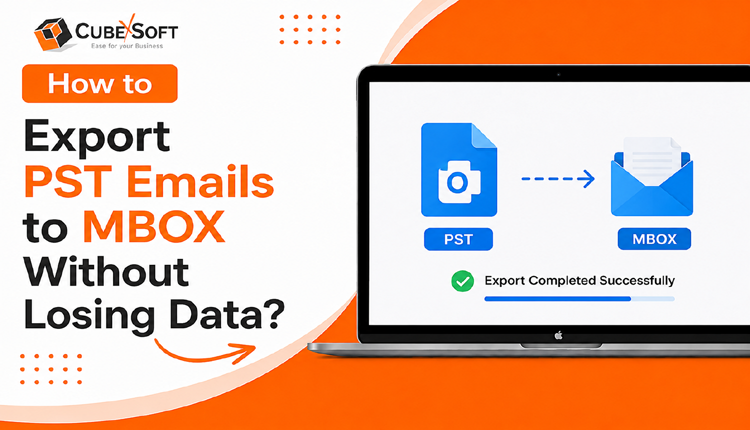
Summary: Managing PST files without Microsoft Outlook can often become challenging, especially when users need to migrate emails to MBOX-supported email clients like Thunderbird, Apple Mail, or Entourage. Since PST files are not directly compatible with these applications, users may face difficulties in accessing or transferring their mailbox data.
To overcome this limitation, this article explains a practical approach for converting PST files into MBOX format on both Mac and Windows systems without requiring Outlook. It also highlights the use of a dedicated PST to MBOX Converter tool that simplifies the entire process and enables direct file conversion with ease.
Reasons to Change PST Files into MBOX Format
PST (Personal Storage Table) files are created and used exclusively by Microsoft Outlook, which limits their compatibility with other email applications. In contrast, MBOX is a widely supported mailbox format that works smoothly with email clients such as Mozilla Thunderbird, Apple Mail, SeaMonkey, Entourage, Eudora, and several Linux-based mail applications.
There are several situations where converting PST to MBOX becomes necessary:
- Users often switch from Outlook to alternative email clients that support open and cross-platform formats.
- Mac users may need access to PST data without installing Microsoft Outlook on their system.
- Organizations may want to migrate older Outlook data into lightweight or open-source email applications.
- PST data may need to be shared with users working on Linux or other non-Outlook email platforms.
After understanding these requirements, it becomes important to explore the available conversion approaches. Like most file conversions, PST to MBOX Converter can be achieved through both manual techniques and professional tools. The following sections explain these methods in detail to help ensure a smooth and error-free conversion process.
Free Ways to Convert PST Files to MBOX Format (Manual Guide)
There are several no-cost approaches available for converting PST files into MBOX format. These methods rely on email clients and indirect transfer techniques to complete the migration process.
Method 1: Convert PST to MBOX on macOS Using Outlook and Apple Mail
Before starting, ensure your PST file is available on your Mac system.
- Open Microsoft Outlook for Mac and import the PST file using the built-in import option.
- Once imported, drag the emails from Outlook to the Mac desktop.
- The exported items are typically saved in .EML format.
- Open Apple Mail and drag these EML files into the application.
- Finally, a third-party utility may be required to convert or organize the data into MBOX format.
Method 2: Export PST to MBOX on Windows via Thunderbird
Begin by ensuring your PST data is accessible in Outlook on Windows.
- Install and configure Mozilla Thunderbird with a temporary or dummy email account.
- Use the import feature in Thunderbird to bring in data from Outlook.
- Select your PST file and complete the import process.
- Alternatively, synchronize Outlook with Thunderbird using IMAP and transfer data via drag-and-drop.
- Install the ImportExportTools NG add-on in Thunderbird.
- Use the add-on to export folders into MBOX format.
Method 3: Cloud-Based Transfer Approach (Windows & Mac)
This method uses Gmail and IMAP synchronization.
- Enable IMAP settings in Gmail.
- Open Microsoft Outlook and ensure the PST file is loaded.
- Connect Outlook and Gmail using IMAP configuration.
- Move or drag PST emails into Gmail folders.
- Use Google Takeout to export mailbox data.
- The downloaded archive will be available in MBOX format.
Why Manual Methods Are Not Always Reliable
Although manual approaches are widely shared, they come with several limitations:
- They depend heavily on having Outlook installed and properly configured.
- Users without Mac or Outlook access may find the process unusable.
- Email structure, metadata, and folder hierarchy may not always be preserved.
- These methods are not suitable for bulk migration or large datasets.
Because of these drawbacks, many users prefer more stable and automated alternatives.
Professional Approach: Convert PST to MBOX without Outlook
A dedicated solution such as the CubexSoft PST Converter Tool offers a more reliable and efficient way to perform PST to MBOX conversion. It works independently of Outlook and supports both Windows and Mac systems.
This tool is designed for both technical and non-technical users and allows batch conversion, selective folder migration, and full data integrity during the process. It also supports exporting PST data into multiple formats, including contacts to VCF and other file types.
Example Use Case
A legal organization managing more than 250 PST files needed access to archived emails on Mac systems without installing Outlook. By using a professional PST to MBOX converter, they successfully converted all files in bulk while preserving folder structure and later imported them into Apple Mail seamlessly.
How the Tool-Based Conversion Works
- Launch the PST converter tool on your system.
- Add the required PST file from local storage.
- Preview mailbox content before conversion.
- Select required folders for export.
- Choose MBOX as the output format.
- Set destination path and apply filters if needed.
- Click Convert to complete the process.
Why Free Online Converters Are Not Recommended
Online conversion tools may seem convenient, but they often come with serious limitations:
- File size restrictions limit large PST uploads.
- Lack of encryption raises security concerns.
- Formatting and email headers may get altered or lost.
- Sensitive data must be uploaded to external servers, increasing risk.
For this reason, offline desktop tools are considered safer and more reliable for professional use.
Final Conclusion
Converting PST files to MBOX format can be achieved through multiple manual techniques, but these methods are often slow, limited, and unsuitable for large-scale migrations. While they may work in basic scenarios, they lack consistency and reliability. For better results, automated desktop-based solutions provide a faster, secure, and more accurate way to perform PST to MBOX conversion on both Mac and Windows systems without relying on Outlook.