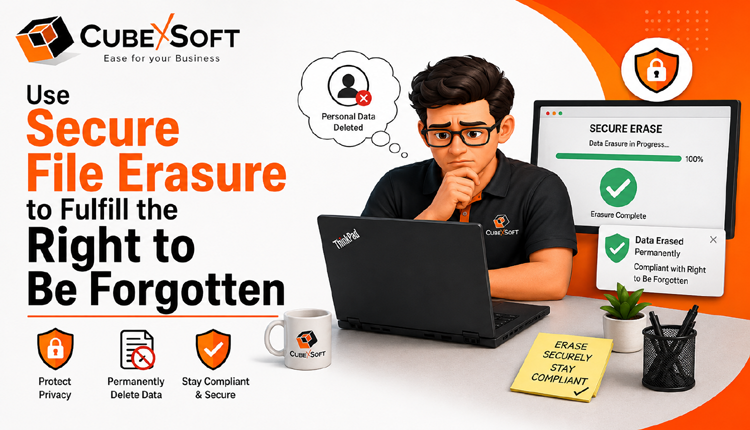
As privacy regulations continue to evolve, organizations are expected to do more than simply delete files when someone requests their personal data to be removed. In many cases, deleted data can still be recovered, which may lead to compliance and security risks. That’s why secure file erasure has become an essential part of meeting the Right to Be Forgotten requirements. In this article, we’ll explain why permanent data erasure matters, how it supports compliance with modern privacy laws, and the best practices for ensuring sensitive information is completely and permanently removed from your systems.
What Is the Right to Be Forgotten?
The Right to Be Forgotten, commonly referred to as the Right to Erasure, gives individuals the right to ask organizations to permanently delete their personal information when there is no legitimate reason to keep it. Although the concept has its roots in the French principle of le droit à l’oubli (“the right to be forgotten”), it became widely recognized when Article 17 of the General Data Protection Regulation (GDPR) came into effect on May 25, 2018. Since then, this right has become a key part of privacy regulations around the world.
Today, the Right to Erasure is not limited to the European Union. Similar data deletion rights are included in several major privacy laws, including the California Consumer Privacy Act (CCPA), California Privacy Rights Act (CPRA), UK GDPR, India’s Digital Personal Data Protection (DPDP) Act, and South Africa’s Protection of Personal Information Act (POPIA). These regulations require organizations to respond to valid deletion requests by removing personal data from all relevant locations, including live systems, cloud environments, archived files, and backup storage.
However, permanently deleting data is more challenging than many organizations realize. Traditional methods such as deleting files, formatting a drive, or performing a factory reset usually remove only the file references, not the actual data stored on the device. As a result, the information may still be recoverable using readily available data recovery software, creating serious privacy and compliance risks.
To fully comply with the Right to Be Forgotten, organizations should use dedicated secure file wiping software that permanently overwrites sensitive data, making it impossible to recover. A reliable data erasure solution should also generate a detailed erasure report, providing verifiable proof that the information has been securely removed. In the following sections, we’ll examine how different privacy regulations approach the Right to Be Forgotten and explore best practices for implementing a compliant data erasure process.
Right to Be Forgotten Around the World
United States and South America
The United States does not have a single federal law dedicated to the Right to Be Forgotten. Instead, several states have introduced privacy regulations that provide consumers with comparable rights.
- California Consumer Privacy Act (CCPA): California residents can request the deletion of personal information collected by businesses, and organizations are generally required to respond within the legally specified timeframe unless an exception applies.
- Brazil’s Lei Geral de Proteção de Dados (LGPD): Inspired by the GDPR, Brazil’s privacy law allows individuals to request the deletion, anonymization, or blocking of unnecessary personal data.
Middle East and Africa
Several countries in the Middle East and Africa have adopted modern privacy laws that include data deletion rights.
- Saudi Arabia’s Personal Data Protection Law (PDPL): Individuals can request the destruction of their personal information once the purpose for collecting it has been fulfilled.
- South Africa’s Protection of Personal Information Act (POPIA): Consumers have the right to request the deletion of personal data that is no longer required or no longer has a lawful basis for processing.
India
India’s Digital Personal Data Protection (DPDP) Act establishes a legal framework for protecting personal information. It grants individuals the right to request the erasure of their personal data, while requiring organizations (known as Data Fiduciaries) to process these requests responsibly.
To comply with the law, organizations must ensure that personal information is permanently removed not only from production systems but also from backups, archives, and any third-party platforms where the data may exist. They should also maintain records that demonstrate the deletion request has been completed successfully.
When Can an Organization Refuse a Deletion Request?
Although individuals have the right to request the deletion of their personal information, this right is not absolute. Privacy laws recognize several situations in which organizations are legally allowed, or even required, to retain certain data.
Some common exceptions include:
- Freedom of Expression and Public Interest: Organizations may refuse a deletion request if retaining the information is necessary to protect freedom of expression, journalism, academic work, or the public’s right to access information.
- Legal and Regulatory Requirements: Businesses often need to retain records to comply with other legal obligations. Financial regulations, healthcare laws, taxation requirements, and similar legislation may require organizations to keep certain data for a defined period before it can be deleted.
- Research and Statistical Purposes: Personal information may continue to be stored if it is required for scientific research, historical archiving, public health initiatives, or statistical analysis, provided appropriate safeguards are in place.
- Legal Proceedings: If the information is needed to establish, defend, or pursue legal claims, an organization may postpone or reject a deletion request until the legal matter has been resolved.
Use CubexSoft Data Eraser Tool to Meet Right to Be Forgotten Requirements
After a deletion request has been approved, the next challenge is ensuring that the data is permanently erased and cannot be recovered. Simply deleting files or formatting a storage device does not completely remove the underlying information, which can leave organizations exposed to compliance and security risks.
The CubexSoft Data Wipe Tool helps organizations securely erase sensitive files from computers, storage devices, and other media using advanced data wiping algorithms. The software permanently removes confidential information, preventing recovery through data recovery tools.
In addition to secure erasure, the tool generates detailed erasure reports that provide verifiable proof that the deletion process has been completed successfully. These reports can be valuable during compliance audits and help organizations demonstrate accountability under privacy regulations such as GDPR, CCPA, DPDP Act, POPIA, and other data protection laws.
With secure data wiping, centralized reporting, and reliable verification, organizations can confidently fulfill Right to Be Forgotten requests while reducing the risk of data leakage and non-compliance.
Conclusion
As privacy laws continue to evolve, organizations need to take data deletion more seriously than ever before. Simply deleting a file or formatting a drive is no longer enough to meet the requirements of the Right to Be Forgotten, as the data may still be recoverable. To truly protect personal information and stay compliant with modern data protection regulations, businesses should adopt secure file erasure practices that permanently remove sensitive data from all storage locations.
A reliable solution like the CubexSoft Data Wiping Tool makes this process much easier by securely erasing data beyond recovery and providing detailed erasure reports for verification. Whether you’re responding to customer deletion requests or strengthening your organization’s data privacy strategy, using a professional file erasure solution helps ensure compliance, reduces security risks, and builds greater trust with customers.