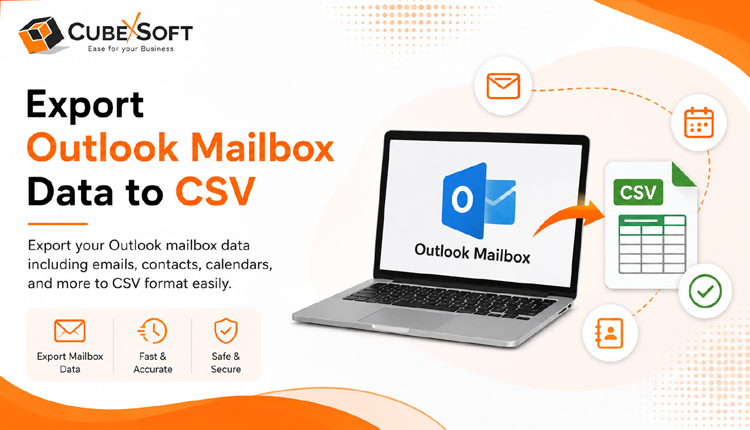
If you are looking for a simple way to export Outlook mailbox data into CSV format, this guide will help you understand the complete process. Outlook stores a large amount of important information, including emails, contacts, and other mailbox details, but managing or analyzing this data outside Outlook can be challenging. By converting Outlook data into a CSV file, users can easily organize, view, and manage mailbox information using spreadsheet applications like Microsoft Excel.
In this article, we will discuss different ways to export Outlook emails to CSV, explain the manual method, highlight its limitations, and explore an efficient approach for users who need to handle large mailbox data. Whether you want to create a record of emails, analyze mailbox details, or prepare data for migration, exporting Outlook data to CSV can make the process more convenient and accessible.
Overview: Outlook & CSV
Microsoft Outlook is widely used for managing emails, contacts, calendars, and other important communication data. However, there are situations where users need to move their mailbox information into a more flexible format for analysis, reporting, migration, or record keeping. CSV (Comma-Separated Values) is one of the most commonly used file formats because it can be opened easily in applications like Microsoft Excel and other spreadsheet programs.
Exporting Outlook mailbox data to CSV allows users to organize email information, maintain offline records, and transfer selected mailbox details without relying completely on the Outlook application.
Why Export Outlook Emails to CSV Format?
There are several reasons why users prefer saving Outlook mailbox data as CSV files. Some common benefits include:
- Easy viewing of email details in spreadsheet applications.
- Simple organization and filtering of mailbox records.
- Convenient sharing of email information with other users.
- Useful format for importing data into different applications.
- Helps maintain a backup copy of important mailbox information.
A CSV file stores data in rows and columns, making it easier to sort, analyze, and manage large amounts of information.
What Data Can Be Exported from Outlook to CSV?
Outlook provides options to export different types of mailbox information depending on your requirements. Generally, users can export:
- Email messages
- Contacts
- Calendar details
- Task information
- Other mailbox-related data
However, when exporting emails, CSV files mainly store email-related details such as sender, recipient, subject, date, and other available fields. Attachments and complete email formatting are not typically preserved in CSV format.
Manual Method to Export Outlook Data to CSV
Outlook includes a built-in Import/Export feature that helps users save mailbox data into CSV files. Follow these steps:
Step 1: Open Outlook Import and Export Wizard
- Launch Microsoft Outlook on your computer.
- Click the File option from the top menu.
- Select Open & Export.
- Choose Import/Export.
Step 2: Select Export Option
- From the wizard, select Export to a file.
- Click Next.
- Choose Comma Separated Values (CSV) as the output format.
- Continue by clicking Next.
Step 3: Choose Outlook Folder
- Select the mailbox folder you want to export.
- Choose the required email folder, such as Inbox or Contacts.
- Select the destination location for saving the CSV file.
- Click Finish to complete the process.
Once completed, Outlook will create a CSV file containing the selected data.
Limitations of the Manual Outlook CSV Export Method
Although Outlook provides a built-in export option, it has some limitations that users should consider:
- The process can be time-consuming for large mailboxes.
- Email attachments are not included in CSV files.
- Maintaining complete email formatting is not possible.
- Export options depend on the Outlook version and configuration.
- Technical users may find the process confusing.
For users who need complete mailbox migration or advanced export options, a professional solution may be more suitable.
How to Export All Outlook Emails to CSV Using an Expert-Recommended Approach?
If you need to export Outlook emails to CSV without dealing with complex manual steps, using a professional conversion tool can make the process faster and more efficient. An expert-recommended solution like CubexSoft Outlook Converter is designed to simplify Outlook mailbox export while providing advanced options for managing PST data.
The tool comes with an auto-detect feature that can automatically locate PST files from their default storage location. If your PST file is saved somewhere else, you can also use the Select File option to browse and add the file manually from any custom location.
With this approach, users can easily load Outlook PST files and export mailbox data into CSV format while maintaining important email details. It is especially useful for users who need to process large Outlook files, multiple PST files, or require more flexibility than the standard Outlook export option provides.
The software also offers advanced filtering and customization features, allowing users to select specific folders, apply date-based filters, and export only the required mailbox data instead of processing the entire Outlook file.
Key Benefits of the Recommended Software
Using a professional Outlook export solution makes managing and converting mailbox data much easier. It provides advanced features that help users handle Outlook files efficiently without the restrictions often found in manual methods.
Some of the major benefits include:
- The software supports converting PST files into multiple formats, including CSV, PDF, MBOX, EML, and more than 35 other export options.
- It comes with an easy-to-use interface, allowing both technical and non-technical users to perform mailbox conversion without complexity.
- Users can export Outlook data with advanced filtering options such as year-wise selection, date range, sender, recipient, subject, folder selection, organizer details, and exclusion of empty folders.
- The tool allows users to migrate PST data directly to platforms like Gmail, Thunderbird, Microsoft 365, and other IMAP-supported email services.
- It can process multiple Outlook files and large mailbox data without file size limitations or unnecessary restrictions.
Best Practices to Maintain Date Accuracy During Export
When exporting Outlook emails to CSV or other formats, maintaining correct date information is important for proper organization and future reference. Follow these practices to avoid date-related issues:
- Use the Custom Map Field option during export to include important date fields such as Sent Date, Received Date, Created Date, and Modified Date according to your requirements.
- Ensure that your Outlook and system regional settings use the correct date format to prevent mismatched date entries in the exported CSV file.
- Apply specific date filters before exporting to select only the required emails and avoid unnecessary mailbox data.
Following these steps helps ensure accurate export results while keeping your Outlook data properly organized and easy to manage.
Final Thoughts
In this article, we have explained different ways to export Outlook emails to CSV format, including the manual method and a professional approach. While the built-in Outlook export option can be useful for basic requirements, it comes with several limitations, especially when dealing with large mailboxes, multiple files, or the need to preserve complete data details.
For users who need a more flexible and efficient solution, an expert-recommended approach can simplify the export process. It helps manage Outlook data of different sizes without the restrictions commonly found in manual methods, making it a more convenient choice for handling mailbox exports, migration, and data management tasks.